Security Alert in Ecuador: Your National ID is Your WiFi Key
Summary: Discover why using your National ID as your WiFi password exposes you to hacks, and learn how to secure your home or business network.
Did you know that most major Internet Service Providers (ISPs) in Ecuador configure your default WiFi password using simply your National ID number (Cédula)?
In Ecuador, your ID number is basically public information. We give it out at pharmacies, supermarkets, banks, and building security desks daily. Using this data as the primary barrier to protect your home or business network is the digital equivalent of leaving your house key hidden under the doormat. Anyone who knows where to look will get in.
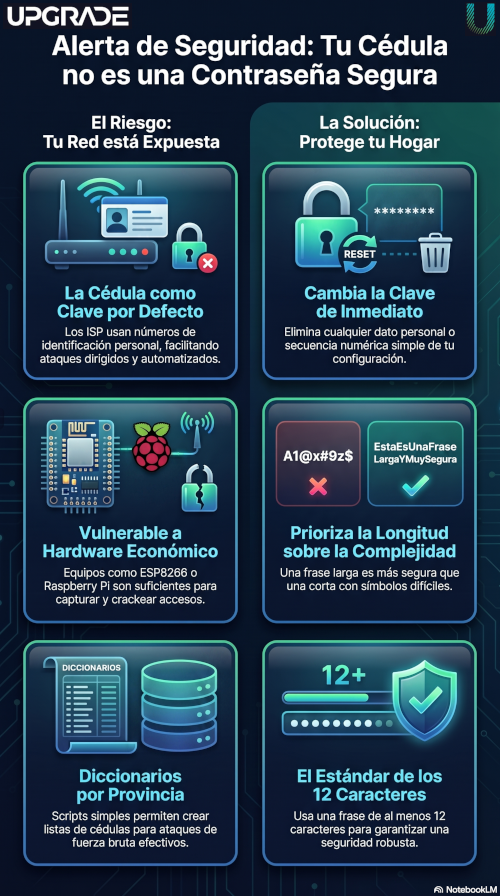
How the Attack Works (No Hollywood Hacker Skills Required)
Compromising a WiFi network secured by an Ecuadorian ID number is alarmingly simple and involves three main steps:
1. Signal Capture (Cheap Hardware)
Modern cyberattacks don’t require expensive gear. An attacker simply needs to sit outside your house or in a parked car with a Raspberry Pi or an ESP8266 microcontroller (devices that cost less than $15). They use these to “listen” to your network traffic and capture the handshake (the invisible verification process that occurs when your phone or laptop connects to the WiFi).
2. Password Decryption (Offline Brute Force)
The real danger happens off-site. The attacker takes that captured handshake back to their computer and uses free software like Hashcat. This program automates brute-force attacks, trying thousands of combinations per second until it cracks yours.
3. The ID Flaw (Mathematically Weak Keyspace)
Here is the technical reality: You might think 10 digits create billions of combinations, but the mathematical structure of the Ecuadorian ID is its biggest vulnerability.
- The first two digits represent the province (01 through 24, or 30).
- The third digit (for citizens) is always less than 6.
- The final digit is a checksum calculated using a strict algorithm (Modulo 10).
This predictable logic drastically reduces the possible combinations. An attacker just needs to run a script following these rules, and a standard computer can crack your WiFi password in a matter of seconds or minutes.
The Ultimate Solution: Passphrases
In modern cybersecurity, the golden rule has shifted: Length beats complexity.
Instead of using short passwords packed with symbols you’ll forget tomorrow, the current standard is to use “Passphrases” of at least 12 to 15 characters.
- ❌ Vulnerable:
tr1ck3y!(Short, hard to remember, quick to crack). - ✅ Bulletproof:
MyDogGoldyRunsInTheMountain12(Long, easy for you to remember, mathematically impossible for an attacker to crack in a reasonable timeframe).
Protect Your Network Today
Your WiFi network doesn’t just provide internet access; it’s the gateway to your security cameras, smart home devices (IoT), phones, and computers containing sensitive financial data.
Change your router’s password today. Remove any personal identification numbers and adopt a long passphrase.
Need professional help? If you aren’t sure how to access your router’s configuration, or if you want to properly audit the security of your business or smart home network, contact me and let’s secure your digital ecosystem.